
The Epstein Files and the Second Silence
We Can Do Hard Things. Institutions Rarely Do.

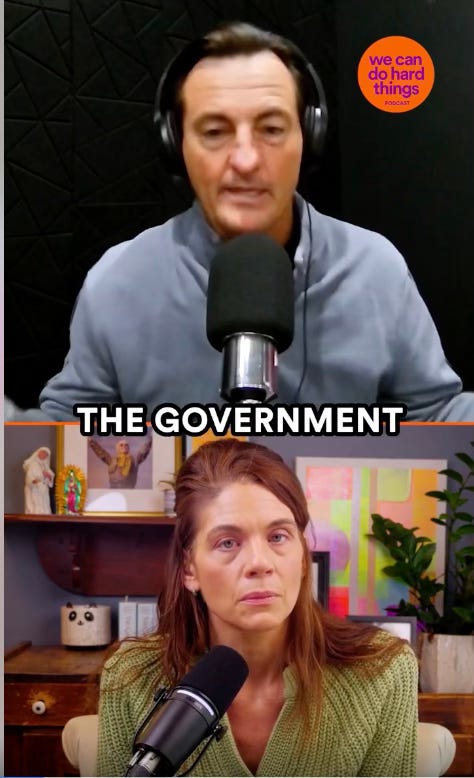
Over the past days weeks, I’ve been listening to Amanda Doyle’s Epstein series on We Can Do Hard Things. What struck me wasn’t the spectacle. It was the structure — the familiar choreography of institutions confronted with harm.
Amanda opens one episode with a a quote from Andrea Gibson that has stayed with me:
“Even when the truth isn’t hopeful, the telling of it is.”
That distinction matters.
Amanda interviews Brad Edwards who has represented Epstein survivors for nearly two decades. Listening to him, I found myself thinking about endurance — not as heroism, but as labor. The long, grinding work of pursuing accountability inside systems that often operate through delay, procedural exhaustion, and containment of liability rather than repair of harm.
Brad and his partner Brittany Henderson reminded me of my own attorneys — Martin Smalline and JoAnn Harri — their steadiness, their professionalism, their refusal to treat survivors as abstractions. In my case, they stayed with it for more than three years. That kind of commitment, undertaken without certainty of outcome, represents a form of sustained moral effort on behalf of people the system has already failed.
What remains painfully visible — in Epstein’s case and in so many others — is what I have come to think of as the second silence survivors experience.
Not the silence of abuse.
But the silence that follows disclosure.
Brad describes warning the Department of Justice about the risks of releasing documents without survivor-informed safeguards:
“I even wrote a letter to Pam Bondi saying, I fear this could happen — that there will be missed redactions and victims’ names will come out.”
He was reassured. That would be childish. That would never happen.
And yet missed redactions did occur.
Victims’ names were exposed.
The consequences of these failures are not abstract.
Survivors have described strangers appearing at their homes.
Full identities rendered searchable.
Depositions containing deeply private material circulating beyond their intended legal context.
Privacy, once surrendered for justice, is surrendered again without it.
Releasing files is not justice.
Transparency absent accountability — absent care and compassion — can reproduce more harm rather than repair it.
Last week, I wrote about how to support survivors particularly during moments of renewed exposure like this one. The advice Brad offers in these conversations echoes much of that guidance: listen without interrogation, resist voyeurism disguised as curiosity, respect boundaries, understand that disclosure does not erase vulnerability.
If you haven’t yet listened to Amanda Doyle’s Epstein series, I strongly encourage it:
EPSTEIN SURVIVORS’ ATTORNEY WHO EXPOSED GOVERNMENT CONSPIRACY — Brad Edwards
THE EPSTEIN FILES, EXPLAINED: Everything You Need to Know
These are not sensational episodes.
They are clarifying ones.
My empathy for survivors runs deep, particularly for those now navigating renewed exposure without repair. The injuries described here are not theoretical. They are lived; psychologically, economically, relationally, bodily.
Even when the truth isn’t hopeful, the telling of it is.
But hope does not reside in disclosure alone.
Hope depends on what institutions choose to do next.
And too often, that is where survivors encounter the second silence.
The system may continue to absorb the harm.
It may continue to protect itself.
But survivors are still speaking.
Still documenting.
Still insisting on reality in a culture organized around forgetting.
And that matters.
Because even when justice stalls, truth does not disappear.
It accumulates.
If you’re reading this and wondering what to do, start here.
What You Can Do
Most people can’t meaningfully influence what the Department of Justice releases, when it releases it, or why it withholds material it is legally required to disclose. But that does not mean there is nothing to do.
The most immediate way to support survivors right now is harm reduction.
Do not circulate “lists,” rumors, or crowdsourced accusations. Naming without due process harms innocent people and undermines real accountability.
Do not amplify graphic content. Clicks, reposts, and commentary reward the very exposure survivors are asking to stop.
Report what you see. Use platform tools to report sexual exploitation, doxxing, or child sexual abuse material.
Support survivor-centered and prevention organizations rather than outrage cycles or influencers monetizing disclosure.
Change the frame in conversation. Transparency is not the same as justice. Ask instead: Who is being protected? Who is being exposed? Who carries the risk?
If the administration is breaking the law by failing to release required materials, oversight belongs with Congress and the courts. The public’s role is simpler—and more urgent: don’t become another vector of harm.
Sometimes the most ethical response is not amplification, but restraint.
Resources
World Childhood Foundation / World Childhood Foundation USA
Supports evidence-based solutions to prevent child sexual abuse and exploitation globally, with a focus on protecting children who are most vulnerable and strengthening the systems meant to keep them safe.MOORE Center for the Prevention of Child Sexual Abuse(Johns Hopkins Bloomberg School of Public Health)
Advances a public-health approach to preventing child sexual abuse through research, training, and scalable prevention programs—treating prevention as both possible and urgent.Internet Watch Foundation – Report Remove
A confidential service (UK-based, available internationally) that allows survivors of child sexual abuse imagery to request removal of images or videos of themselves from the internet—securely and without having to repeatedly contact websites or relive their trauma.Thorn
Builds technology and research-based tools to reduce the spread of child sexual abuse material online and to help platforms, law enforcement, and communities prevent and identify harm.